From the outset, the FIA and Formula 1 have emphasized that the 2026 technical regulations are designed to make the cars lighter, more compact, and more manageable to drive. The changes are intended not only to simplify the engineers’ work when optimizing car setups, but also to improve drivability, making the cars less demanding and more predictable for drivers.
All of these measures pursue several objectives simultaneously: to intensify on-track competition, enhance overall safety standards, and reduce the championship’s environmental impact.
CAR DIMENSIONS AND WEIGHT
The overall dimensions of the cars will be significantly reduced.
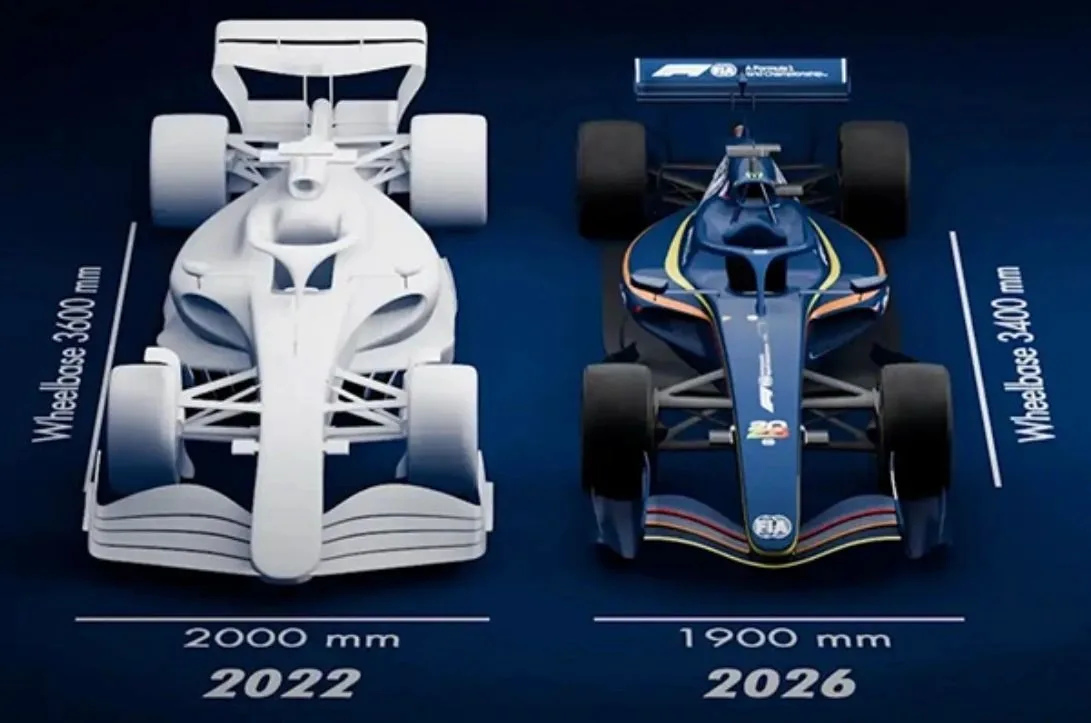
The maximum wheelbase is limited to 3400 mm, which is 200 mm shorter than at present. The maximum chassis width has been reduced to 1900 mm, while the floor width has been narrowed by 150 mm.
The minimum car weight during sprint qualifying and qualifying sessions will be 726 kg, excluding the nominal tyre mass. In all other sessions, the minimum weight is set at 724 kg, again excluding tyres.
If a heat hazard condition is declared and drivers are required to use additional cooling equipment, the minimum weight will be increased by 5 kg.
The nominal tyre mass, as defined by the sole tyre supplier Pirelli, is approximately 46 kg.
AERODYNAMICS
According to FIA calculations, downforce will be reduced by approximately 30%, while aerodynamic drag will decrease by as much as 55%. This is expected to make the cars less sensitive to turbulent air and allow closer wheel-to-wheel racing.
The DRS system will be discontinued, replaced by active aerodynamics. Movable aerodynamic elements will be fitted to both the front and rear wings.
Corner Mode — increased angle of attack and maximum downforce for cornering
Straight Mode — reduced angle of attack to minimize drag and maximize straight-line speed
Mode transitions must occur within 400 milliseconds, and each movable element is limited to two fixed positions.
Venturi tunnels and strong ground-effect aerodynamics are being phased out. The floor will be flatter and the diffuser less aggressive, reducing the need for extremely stiff suspension settings.
The FIA has also tightened regulations regarding aerodynamic flexibility. In the event of any suspicion, teams will be required to demonstrate that no aerodynamic components deform while the car is in motion.
POWER UNIT
The fundamental architecture remains unchanged: a 1.6-litre turbocharged V6, though the power distribution has been substantially revised.
Internal combustion engine output has been reduced to 400 kW, while the hybrid system output has nearly tripled to 350 kW.
The MGU-H has been eliminated, simplifying the power unit and reducing costs.
Energy recovery has been increased to 8.5 MJ per lap, and a new Overtake Mode has been introduced to facilitate overtaking, replacing the DRS system.
FUEL
From 2026 onward, Formula 1 will exclusively use 100% synthetic fuel derived from renewable sources. The fuel will be standardized and, in principle, suitable for use in conventional road cars.
TYRES
Wheel diameter remains at 18 inches, but tyre widths have been reduced:
Front tyres by 25 mm
Rear tyres by 30 mm
SAFETY
The front impact structure has been redesigned as a two-stage assembly, while the side impact structures are now more than twice as strong, without any increase in weight.
The roll hoop must now withstand loads of 20G, and rear warning lights and additional light panels have been enhanced to improve visibility and safety.
2026 TERMINOLOGY
Overtake Mode — additional electrical energy for overtaking when within one second of a rival
Boost Mode — instant access to maximum combined power for attack and defense
Active Aero — driver-controlled aerodynamic modes
Recharge — expanded energy recovery and battery recharging capabilities
QUALIFYING FORMAT
With the entry of Cadillac and the increase in the number of drivers from 20 to 22, six drivers will be eliminated in both Q1 and Q2, instead of five.